Planets · Asteroid
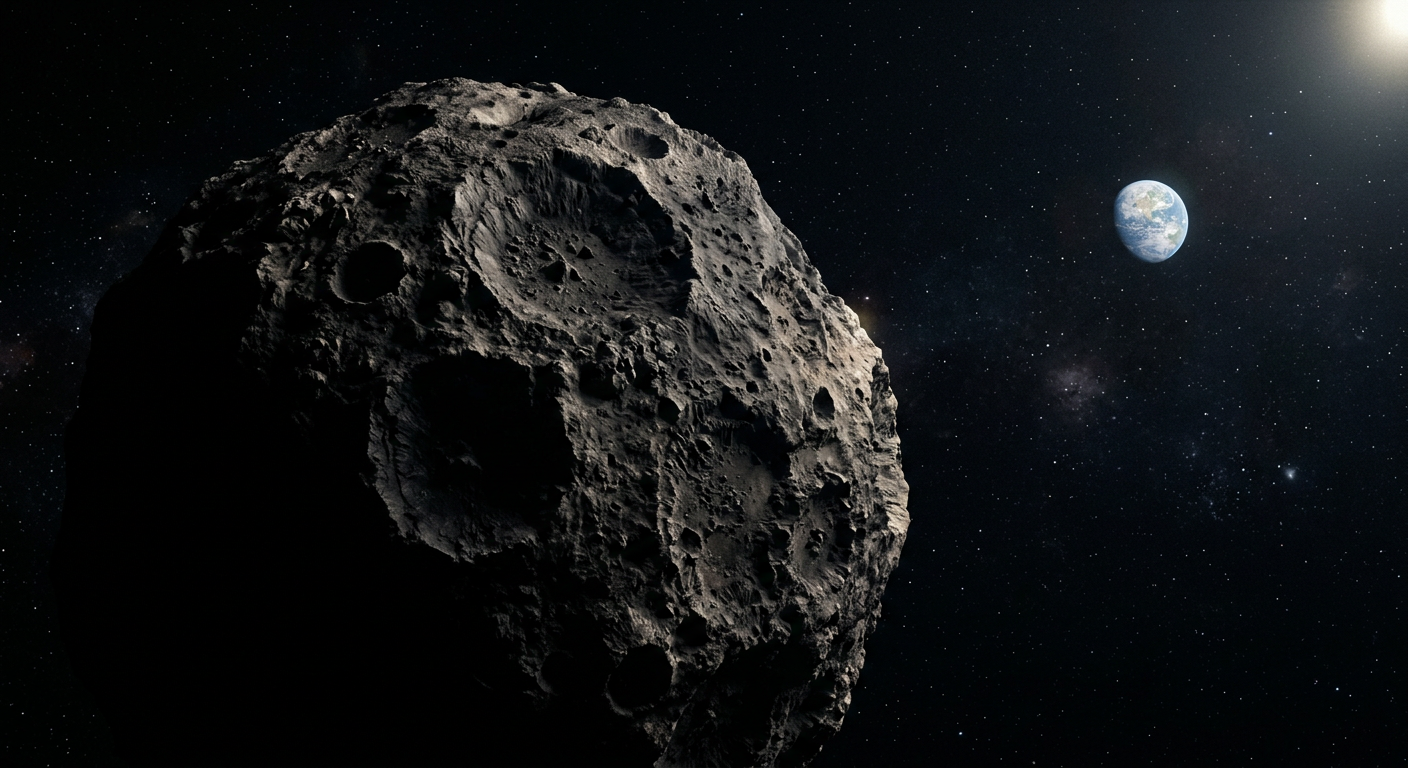
What happens when a mountain from space is on course to hit Earth?
A faint moving dot on a telescope image. Is it nothing, or everything?
- near-Earth asteroids catalogued
- 35,000+
- orbit change achieved by DART
- 32 min
- size that could devastate a region
- 140 m
01
A dot that moves
Survey telescopes photograph the same patch of sky several times a night. Stars stay put. Anything that shifts position between frames is closer — an asteroid or comet in our own solar system.
02
From discovery to orbit
One detection tells you little. Repeated observations over days and weeks pin down the orbit and shrink the uncertainty about where the object will be years from now. Most scary early predictions fade to zero this way.
03
Pushing back
In 2022, NASA’s DART spacecraft hit the asteroid moon Dimorphos and changed its orbit. For the first time, humanity proved it could nudge a space rock. The earlier we find a threat, the smaller the nudge needed.
Your mission
3 Ops, about 6 minutes
- 1Tactical · SPOTSpot the moving object
- 2Tactical · PREDICTPredict what happens next
- 3Technical · CALCULATECalculate time to arrival
Evidence you can earn
Competencies this mission builds
- Observation & Anomaly DetectionNoticing what is different, moving or out of place in images, signals and data.Up to L2
- Trajectory ReasoningReasoning about where an object is going, when, and what could change its path.L1
- Orbital CalculationUsing quantities like speed, distance and period to put numbers on motion in space.L1
- Risk AssessmentWeighing likelihood and consequence to decide when and how to act.L1
Leads toward Planetary Defense Scientist, Astronomer, Orbital Analyst.