Orbit · Debris
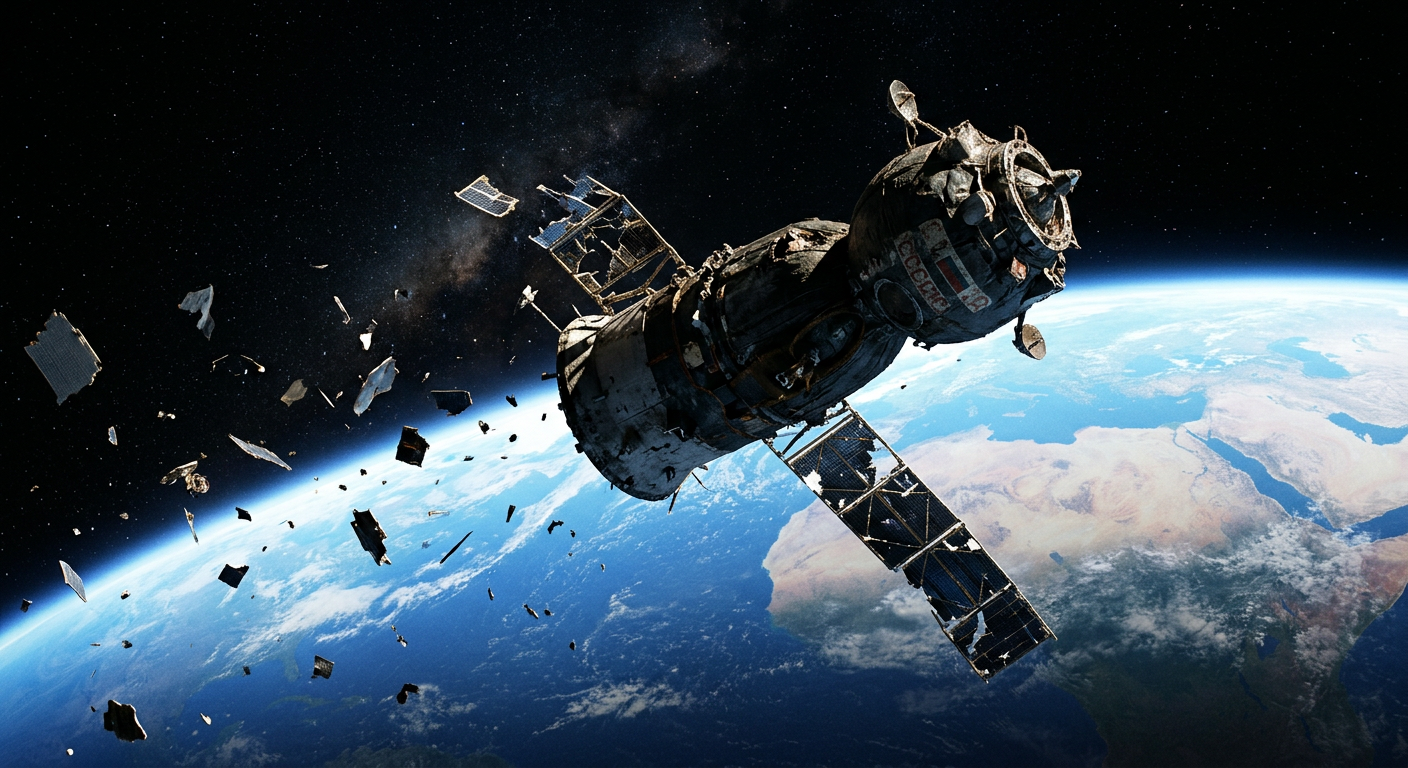
What happens when dead machines still fly?
A paint fleck at orbital speed hits like a bullet. There are millions of them.
- tracked objects over 10 cm
- 36,000+
- typical speed in low Earth orbit
- 7.5 km/s
- estimated fragments 1–10 cm
- 1M+
01
A crowded shell
More than 36,000 objects larger than a fist are tracked in Earth orbit. Most are not working satellites — they are spent rocket stages, dead spacecraft and fragments from explosions and collisions.
02
Nothing slows down
In low orbit there is almost no air to stop them. A fragment keeps circling at around 7.5 km/s for years or decades. When two objects meet, the closing speed can exceed 10 km/s.
03
The chain reaction
In 2009, a dead Russian satellite collided with an active Iridium satellite and created thousands of new fragments. Each fragment raises the odds of the next collision. Watching, predicting and managing that risk is now a full-time job.
Your mission
3 Ops, about 6 minutes
- 1Tactical · SPOTSpot the debris
- 2Tactical · PREDICTPredict the consequences
- 3Technical · CALCULATECalculate the impact energy
Evidence you can earn
Competencies this mission builds
- Observation & Anomaly DetectionNoticing what is different, moving or out of place in images, signals and data.L1
- Trajectory ReasoningReasoning about where an object is going, when, and what could change its path.L1
- Risk AssessmentWeighing likelihood and consequence to decide when and how to act.Up to L2
- Space Governance & Policy ReasoningReasoning about the rules, responsibilities and shared risks of using space.L1
Leads toward SSA Analyst, Orbital Analyst, Space Policy Analyst.