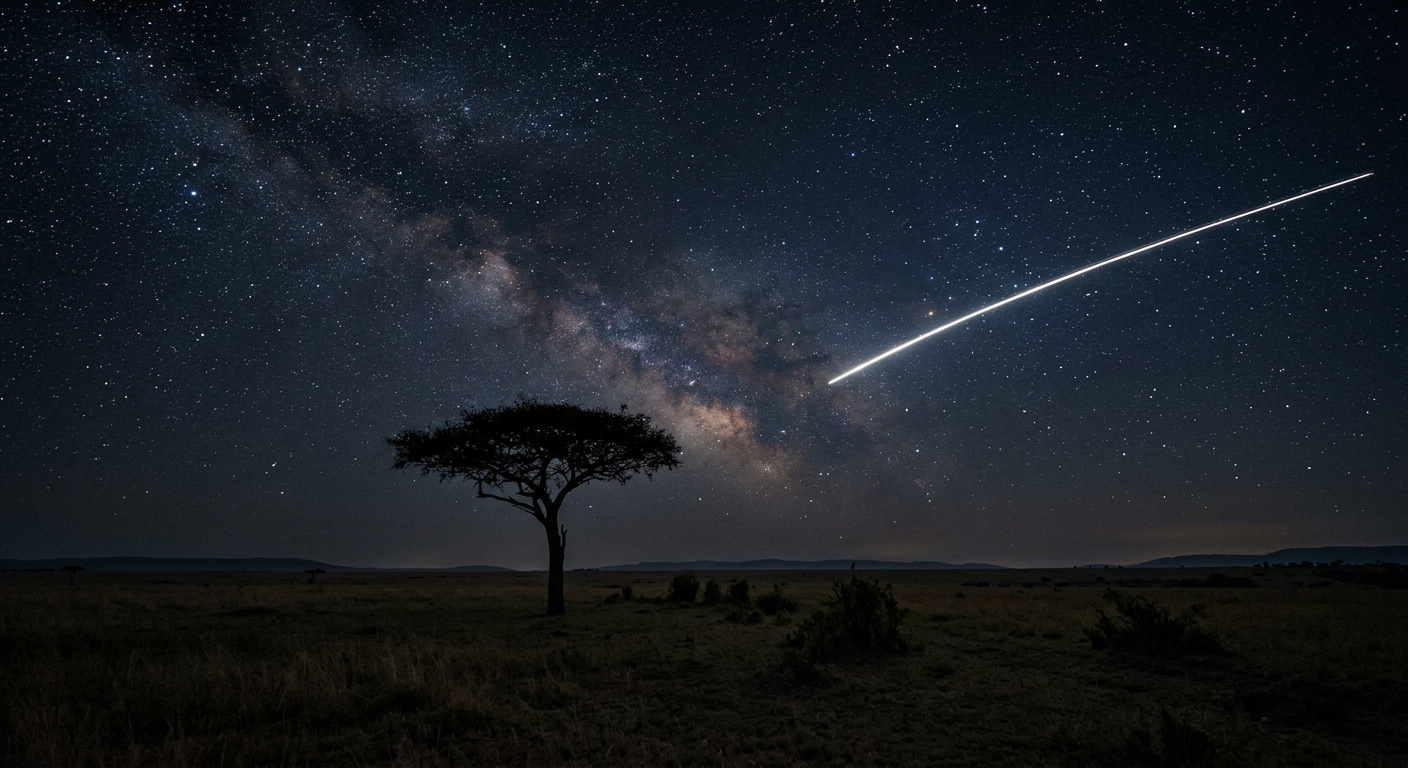
Orbit · ISS
The ISS passes over you tonight. Can you spot it?
A football-pitch-sized laboratory crosses your sky in four minutes. Know when to look.
- average altitude
- 420 km
- orbital speed
- 28,000 km/h
- orbital inclination
- 51.6°
01
A moving star
The International Space Station orbits about 420 km above Earth. It has no lights bright enough to see — what you see is sunlight bouncing off its solar arrays, making it one of the brightest objects in the night sky.
02
The twilight window
You can only see it when your sky is dark but the station is still in sunlight. That happens for an hour or two after sunset and before sunrise. Outside that window, it is up there, invisible.
03
Thinking like mission control
Predicting a pass means knowing the orbit, the time, your location and where Earth’s shadow falls. Mission operators use the same reasoning to schedule communications, dockings and experiments.
Your mission
3 Ops, about 6 minutes
- 1Tactical · PREDICTPredict the pass
- 2Tactical · COMPAREChoose the better pass
- 3Technical · CALCULATECalculate orbits per day
Evidence you can earn
Competencies this mission builds
- Trajectory ReasoningReasoning about where an object is going, when, and what could change its path.Up to L2
- Mission OperationsRunning a mission in real time: timing, windows, procedures and contingencies.L1
- Orbital CalculationUsing quantities like speed, distance and period to put numbers on motion in space.L1
Leads toward Mission Operations Specialist, Orbital Analyst, Astronomer.