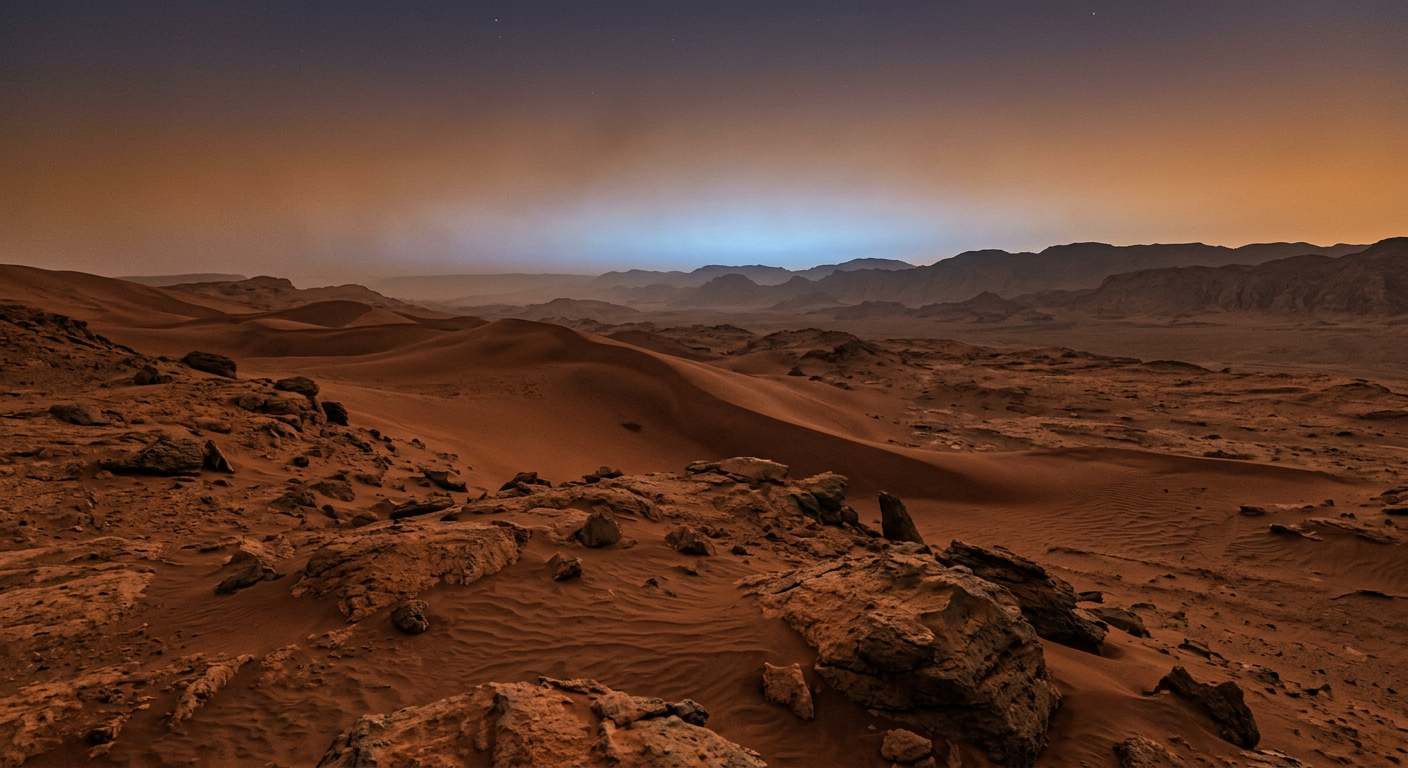
Planets · Mars
If we left tomorrow, what would actually kill you on Mars?
Not aliens. Not storms. Something far quieter — and much faster.
- of Earth’s surface pressure
- 0.6%
- average surface temperature
- −60 °C
- one-way travel time
- 7–9 mo
01
The thin air
Mars’ atmosphere is less than 1% as dense as Earth’s, and almost entirely carbon dioxide. Step outside unprotected and the low pressure would make your body fluids begin to boil within seconds.
02
The slow threats
Even protected, you face an average temperature of −60 °C, toxic perchlorates in the soil, and radiation with no magnetic field to deflect it. These do not kill quickly, but they shape every design decision.
03
Making air
NASA’s MOXIE experiment on the Perseverance rover proved that oxygen can be made from Martian CO₂. Scaling that up — and balancing it against limited power — is the life-support puzzle of the century.
Your mission
3 Ops, about 6 minutes
- 1Tactical · PRIORITISERank the killers
- 2Tactical · COMPARECompare mission choices
- 3Technical · SIMULATESimulate oxygen for four
Evidence you can earn
Competencies this mission builds
- Habitat/Life-Support SystemsKeeping humans alive where the environment is trying not to.L1
- Risk AssessmentWeighing likelihood and consequence to decide when and how to act.L1
- Simulation & Model ReasoningUsing models to test decisions before reality does it for you.Up to L2
Leads toward Planetary Scientist, Space Systems Engineer, Aerospace Engineer.