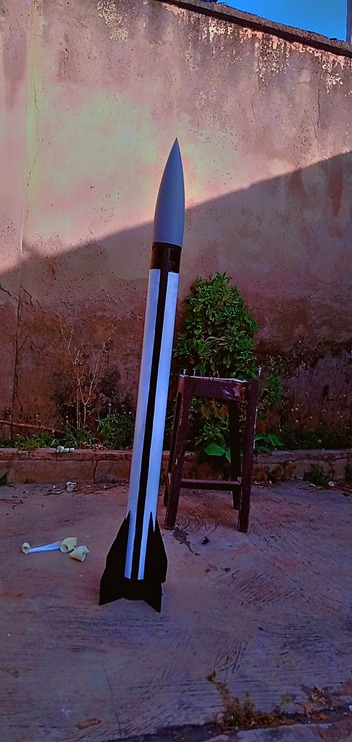
From Concept to Prototype
Every Great Mission Begins With Building.
Explore the engineering process behind UNIVAST's experimental rocket—from early structural components and fabrication to the assembled prototype.
- 01Documented
Component Development
Structural materials are sourced and cut by hand, including body tubing and ring components for the airframe.
- 02Documented
Additive Manufacturing
Parts such as the nose cone are produced on a 3D printer, so the shape can be refined and reprinted as the design changes.
- 03Documented
Airframe Assembly
The body tube and stabilising fins are put together to form the vehicle’s structure.
- 04Assembled · Systems pending
Prototype Integration
The airframe, nose cone and fins come together as one finished prototype. Onboard systems are still to be integrated and tested.
Engineering & Technology
Engineered to Explore. Built to Learn.
The experimental rocket programme brings together structural engineering, onboard instrumentation, flight-data analysis and recovery-system development.
- In design
Aerial Observation
Designed to support onboard imaging for post-flight observation and analysis.
- In design
Location Tracking
GPS-based positioning is included in the system design to support flight-data analysis and recovery.
- Planned
Flight Data & Instrumentation
Planned onboard instrumentation supports the recording and analysis of flight motion, atmospheric pressure and environmental conditions.
- Concept
Recovery Systems
The vehicle incorporates a parachute-recovery concept designed to support controlled descent and retrieval.
Technical snapshot
- Vehicle type
- Experimental model rocketNon-orbital
- Development stage
- Prototype developmentCurrent
- Vehicle length
- ≈ 1 mSubject to final confirmation
- Launch mass
- ≈ 1.5 kgEstimate · not an as-flown value
- Instrumentation
- Flight computer, GPS, motion and environmental sensorsPlanned
- Recovery concept
- Parachute-assisted recoveryConcept
The wider programme aims for an altitude of about 1 km. This is a long-term goal, not a verified result or a validated prediction for the current prototype. Flight performance will only be published once it has been measured.
Engineering contributors
Samuel Gboyinde
Aerospace Engineer
Mission Progress
Progress Is Engineered.
Follow the key stages of UNIVAST's experimental rocketry development programme.
- Documented
- In Development
- Planned
Flight profile
Instrumentation & Systems Integration
Fitting the planned onboard systems into the vehicle: flight computer, GPS positioning, motion and environmental sensors, and the parachute recovery system.
- Milestone 1Documented
Prototype Fabrication
Structural components, a 3D-printed nose cone and a fin-stabilised airframe have been made and assembled into a prototype.
Photographed · see the development gallery - Milestone 2In DevelopmentVerification pending
Instrumentation & Systems Integration
Fitting the planned onboard systems into the vehicle: flight computer, GPS positioning, motion and environmental sensors, and the parachute recovery system.
- Milestone 3PlannedVerification pending
Ground Testing & Validation
Testing whether the flight systems are ready and checking that their measurements are accurate. Integrated vehicle readiness has not been confirmed yet.
- Milestone 4Planned
Experimental Flight
A future non-orbital experimental flight. Dates and results will be published here once they are confirmed.
Be Part of the Mission
The Next Frontier Needs More Builders.
Whether you're an aspiring aerospace engineer, a university, an industry professional or an organisation interested in advancing technical capability, there's an opportunity to follow and support UNIVAST's engineering journey.
Explore Partnerships
Work with UNIVAST to grow practical aerospace engineering capability, from student participation to technical collaboration and sponsorship.
- Universities
- Research institutions
- Engineering organisations
- Corporate sponsors
- Technology partners